
A refusal of recognition as a Polish citizen can be issued over just two traffic tickets. However, a traffic fine does not automatically determine the outcome of the case. The authority must evaluate not only the violation itself, but also the severity and nature of the incidents, the time that has passed, and the applicant’s overall conduct.
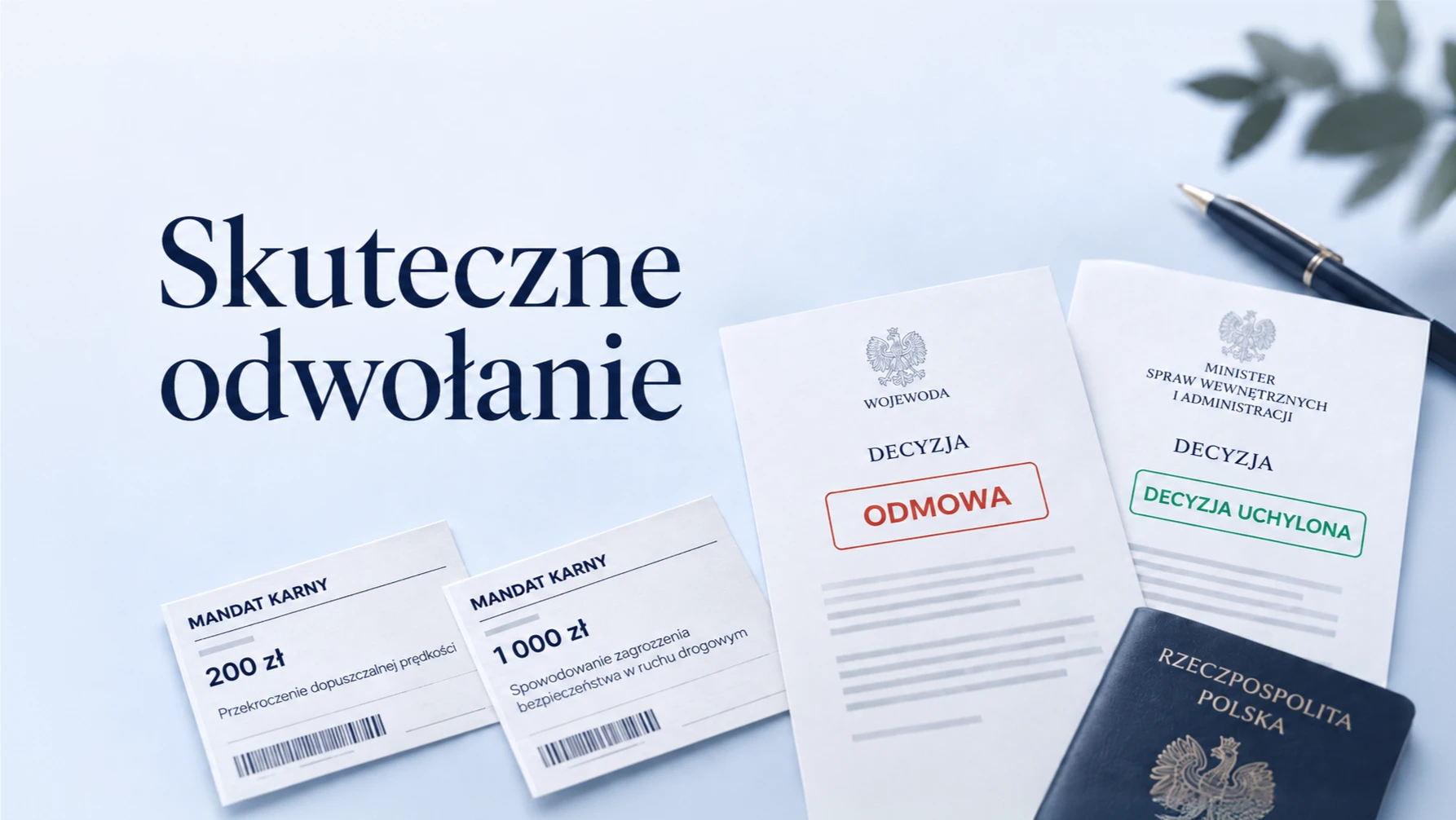
In a case handled by our law firm, the Voivode refused to recognize a client as a Polish citizen based solely on two traffic offenses. Following our appeal, the Minister of the Interior and Administration (MSWiA) overturned the negative decision and granted citizenship directly. The appeal process took one month.
Key Takeaways From This Case
- A penalty fine imposed for a traffic offense can result in a citizenship refusal, even if the applicant meets all statutory residency requirements under the Polish Citizenship Act (t.j. Dz. U. z 2025 r. poz. 1611 ze zm.).
- Every legal violation requires an individual assessment. A violation cannot automatically be treated as a threat to public safety or public order.
- An effective appeal must detail the circumstances of the events, submit supporting documents, and demonstrate that the violations were only incidents.
- The second instance authority (MSWiA) can both revoke the Voivode’s decision and issue a final ruling granting Polish citizenship.
- The deadline to appeal is 14 days from the date the refusal decision is delivered.
Refused Recognition as a Polish Citizen Due to Two Fines
The client, a Ukrainian citizen, had resided in Poland continuously since 2008. For over three years, he held EU long-term resident status. He submitted his application for recognition as a Polish citizen under Article 30(1)(1) of the Polish Citizenship Act.
(To learn more about the available pathways and requirements, read our guide: How to Get Polish Citizenship for Foreigners).
During the proceedings, the authority established that the client had received two traffic fines:
- 200 zł for exceeding the speed limit by 16–20 km/h,
- 1,000 zł for an offense under Article 86 § 1 of the Petty Offences Code (causing a threat to traffic safety).
These events occurred approximately one and two years before applying for citizenship. Aside from these incidents, the client had no other legal violations in Poland.
Why Did the Voivode Deny the Application?
The refusal was based on Article 31(2) of the Polish Citizenship Act. Under this provision, citizenship is denied if acquiring it poses a threat to national defense, state security, or the protection of public safety and public order.
The Voivode stated that intentional traffic violations demonstrated a lack of respect for the legal order and rules of social coexistence. On this ground, the authority concluded that granting citizenship would threaten public safety.
There were no other negative factors. The refusal rested entirely on these two traffic tickets.
Does Every Traffic Fine Imply a Threat to Public Order?
No. Committing a minor offense should not automatically lead to the conclusion that a foreign national poses a public threat under Article 31(2) of the Act of Citizenship. Such an assessment must account for the specific facts of the case.
The authority should not limit its evaluation to the simple fact that a rule was broken. An individualized assessment is required, considering the nature of the infraction, its impact on the applicant’s overall situation, and whether a genuine threat exists.
Our legal defense focused on arguing that two isolated traffic incidents cannot justify such a far-reaching conclusion. The appeal also relied on established administrative court verdicts.
Legal Arguments Presented in the Appeal to the MSWiA
An appeal was submitted to the Minister of the Interior and Administration. The defense strategy extended beyond stating that the fines were minor traffic matters. We presented the case in a broader context: addressing both the specific incidents and the client’s long-standing integration in Poland.
The appeal explained why the Voivode’s decision was not justified and showed that there was no basis to say that the client posed a real or current threat to public safety. We also stressed that each case must be assessed individually.
In proceedings like this, legal arguments must directly address the justification in the refusal decision rather than simply citing court rulings.
MSWiA Overturned the Decision and Granted Polish Citizenship
The Minister of the Interior and Administration accepted our arguments. The Minister overturned the Voivode’s decision and recognized the client as a Polish citizen.
This made it unnecessary to return the case to the Voivode for re-examination. It was a decision under Article 138 § 1(2) of the Code of Administrative Procedure, bringing a final and favorable conclusion to the case.
The entire appeal process took one month. However, exact processing times depend on factors such as the authority’s workload and whether additional evidence is required.
How an Immigration Lawyer Can Help After a Citizenship Refusal
A negative decision is not final. During a legal consultation, we analyze the decision, verify procedural deadlines, and review the evidence. We then outline the available grounds for appeal and prepare a comprehensive defense strategy.
What to Do After Receiving a Refusal Decision?
An appeal against a Voivode’s decision must be submitted to the Minister of the Interior and Administration through the Voivode who issued the initial ruling. The statutory deadline is 14 days from the date of delivery.
Upon receiving a refusal, you should immediately secure:
- The original refusal decision,
- The envelope showing the tracking number or proof of delivery date,
- Copies of all documents previously submitted in the case,
- Documentation clarifying the circumstances of the alleged violations,
- Evidence regarding your family, professional status, and integration into Polish society.
Next, it is necessary to determine whether the Voivode properly evaluated the evidence and correctly applied the law. The appeal must directly challenge the authority’s reasoning rather than simply repeating the initial application details.
Frequently Asked Questions (FAQ)
Can traffic fines result in a Polish citizenship refusal?
Not automatically. Traffic fines can be evaluated during citizenship proceedings, but the authority must consider their severity, frequency, timing, and the applicant’s overall conduct. The result depends on the totality of the circumstances.
What is the deadline to appeal a Polish citizenship refusal?
The deadline to submit an appeal is 14 days from the date you receive the decision. The appeal is addressed to the MSWiA and submitted through the issuing Voivode.
Can the MSWiA overturn the Voivode’s decision and grant citizenship directly?
Yes. As the appellate body, the MSWiA can overturn the Voivode’s ruling and issue a final decision on the merits, granting citizenship without sending the case back for re-examination.
Can a minor offense cause a citizenship refusal?
No. When evaluating an infraction, authorities review the nature of the act, the fine amount, the frequency of violations, and post-incident conduct. Isolated minor incidents are assessed differently than repeated or severe violations.
Is every appeal against a citizenship refusal successful?
No. It depends on the facts and legal grounds of each case. However, this case shows that a refusal based only on traffic fines can be overturned if the authority did not properly assess the case.
Need Legal Assistance With Your Polish Citizenship Appeal?
If you have received a refusal and need to evaluate your legal options, contact our law firm. After analyzing your case documents, we will present the available legal remedies.